Blinker Fluid
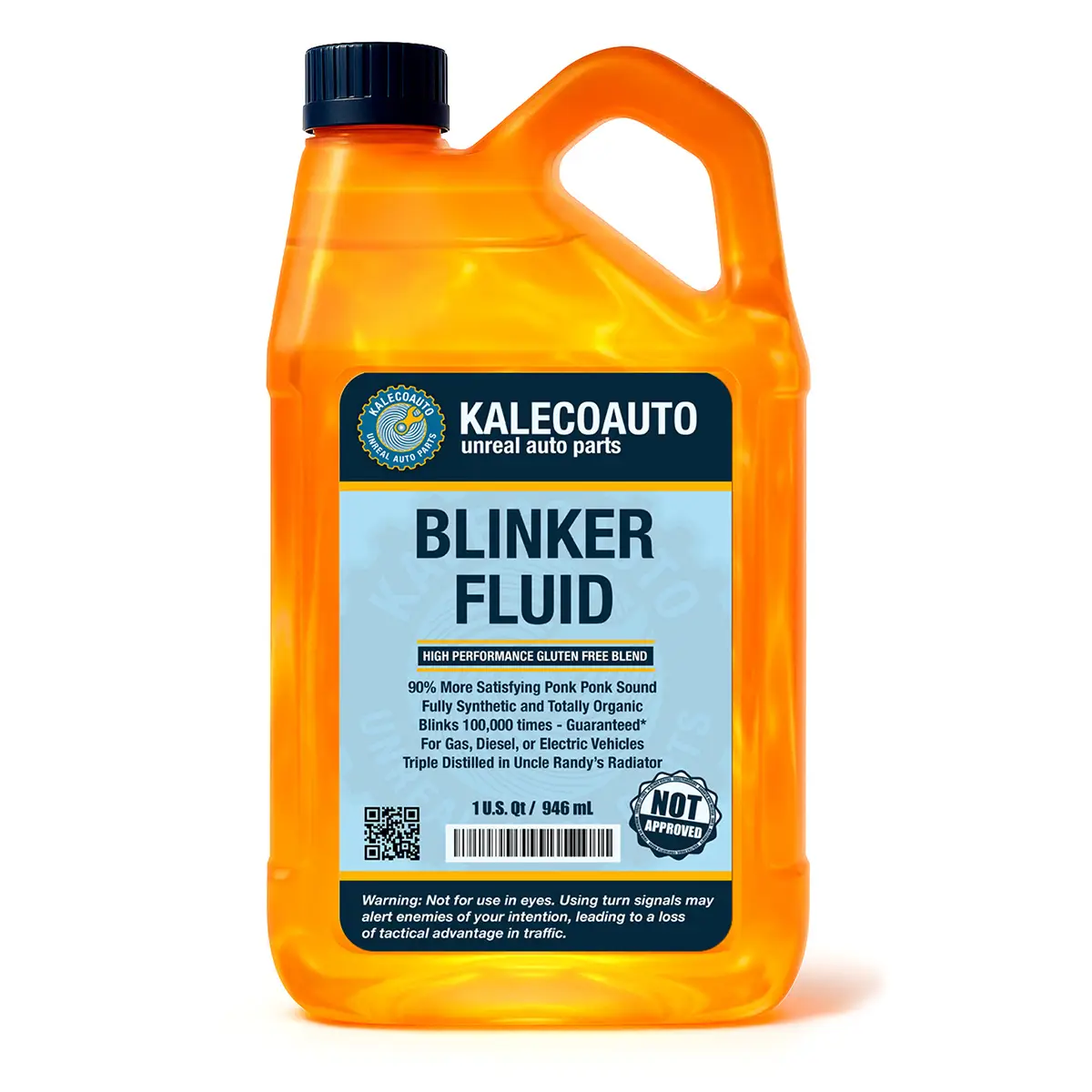
The Internet’s Original Blinker Fluid
SKU: KCA-2001-BLNKR
Experiencing rapid-fire clicking or “hyper-flashing” from your turn signal relay? This condition is commonly associated with abnormal load conditions or insufficient hydraulic pressure within the blinker fluid system. Our OEM-grade synthetic fluid restores proper flash intervals and lubricates filament bearings to help prevent premature indicator burnout.
Our All New Original Blinker Fluid delivers a clean, gluten-free blink compatible with all known headlight fluid and indicator fluid standards. It’s brighter, smoother, and finished with a bold 100% artificial orange formulation.
It’s time to give your turn signals the smooth, confident glow they were made for.
Benefits
- Quietest blink ever recorded in a non-laboratory environment
- Enhanced clarity for sharper, more decisive signaling
- Compatible with all headlight fluid and indicator fluid specs
- Refined gluten-free formulation for gastric performance
- Artificial orange flavor
- Stabilized against seasonal blink fade and passive-aggressive turn-offs
Specifications
- Viscosity Index: 0W-Blink (Synthetic/Organic Hybrid)
- Blink Stability: ±0.001% variance at idle
- Compatibility: Standard Amber, Hyper-White, and Neon
- Photon Density: 4.2 Gigalumen-seconds
- Blink Capacity: 180,000 blinks
- Toxicity (LD50): >90,000 mg/kg (Oral, Other) - Statistically identical to dihydrogen-monoxide
Overview
Most people think that rhythmic clicking sound in the dashboard is just how a turn signal works. However, it could be a sign of turn signal malfunction. Excessive blinker noise is actually the sound of your signal pump running dry and grinding against the housing because the factory fluid evaporated years ago. When the fluid gets low, the light has to work harder to push through the lens, which is why older cars always seem so angry in traffic.
We developed this organic-synthetic blend to silence that relay and get everything flowing smoothly again. It lubricates the flash-synchros to restore that confident, silent operation your car had when it was new. Plus, it is designed to last at least 150,000 blinks, or until you forget to turn your signal off and drive ten miles down the highway with it on. Whichever comes first.
This fluid is compatible with every make and model on the road, even vehicles from Munich where it enjoys lifetime durability (from lack of use). It is fully formulated to work with standard Halogen reservoirs, modern LED fluid-injection systems, and even the notoriously leaky hydraulics found in old British roadsters. Whether you are driving a lifted truck with tow mirrors the size of ironing boards, or a hybrid that signals silently to save the planet, our viscosity stabilizers ensure the light output is a crisp, legally compliant amber. This quality fluid is also fully suitable as headlight fluid in any application. The true and final solution for problem for when your turn signals aren't on the blink.
Application
Compatible with LED, halogen, laser, and other signaling technologies that currently exist or will be invented shortly. Blinker fluid types must not be mixed, combined, blended, layered, or otherwise introduced to one another. When changing formulations, the system must be fully flushed to avoid unpredictable blink behavior, temporal confusion, or the impression that the vehicle is thinking very hard about turning. Indicated for use with any indicator lights you can find.
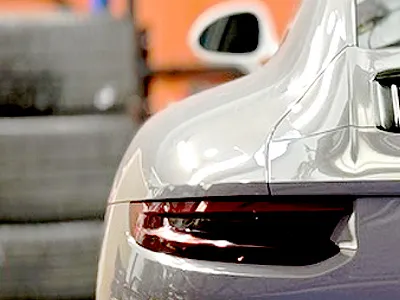
Typical turn signal location
Installation
RTFM - Read The Flippin' Manual
🔧 TECHNICAL SERVICE BULLETIN: Ensure the vehicle is in "Park" before attempting to access the blinker fluid reservoir. Failure to depressurize the headlight assembly may result in fluid spray.
Step 1: Diagnostics Locate the turn signal housing behind the headlight assembly.
- Inspect the reservoir for low fluid levels.
- If the blinker sound is louder than the light output, or if the flash is "dry" and brittle, the system requires immediate service.
- Remove the filler cap counter-clockwise.
Step 2: Surface Preparation Clean the area surrounding the fill port with a lint-free cloth. Any debris entering the reservoir can clog the flasher relay lines, leading to uneven blink intervals. Ensure the rubber gasket is seated correctly before proceeding.
Step 3: Fluid Deployment Insert the nozzle into the reservoir opening. Pour the Blinker Fluid steadily until the level reaches the "MAX" fill line on the housing. Do not overfill; the fluid requires head-space for thermal expansion during heavy traffic or indecisive lane changes.
Step 4: Calibration Reinstall the cap securely. Enter the vehicle and cycle the turn signal lever left and right five times. This primes the lines and circulates the fluid into the bulb chamber, ensuring consistent color temperature and viscosity.
Step 5: Verification Turn indicator or blinker stalk to the left while watching turn signals. Then, turn the indicator to the right. Optional: Set hazard lights.
Pass: Indicator flashes at a steady, rhythmic interval with high-intensity amber refraction.
Fail: Rapid clicking or solid illumination. Action: Check for air pockets in the line and top off fluid; tap the housing firmly to dislodge bubbles.
⚠️ SAFETY NOTICE: Please follow all safety protocols outlined in Bulletins 404, 418. Ensure vehicle is in Park and engine is Off unless you enjoy excitement and hate your fingers. Note: These instructions are proprietary to KaleCoAuto; applying them to generic produts may result in catastrophic failure.
FAQ
What happens if blinker fluid runs low?
Symptoms include: Rapid or irregular blinking, obnoxious clicking noises, and inability to merge.
How often should blinker fluid be changed?
Every 180,000 blinks, 5 years, or if the fluid becomes dingy and loses its glow.
Is blinker fluid compatible with all vehicles?
Yes. Blinker fluid is compatible with all vehicles. Even certain German vehicles, believe it or not.
Is blinker fluid real?
Yes. More accurately, no. It’s a prank, a mechanic joke, and sometimes sold as a novelty product. (See below.)
Who invented blinker fluid?
Blinker fluid is nearly as old as blinkers themselves. While we can't take credit for it, we are the internet's first source for Blinker Fluid.
Why don't people use their turn signals?
An age old question posted with the invention of indicator arms by Florence Lawrence up until the turn signal was patented in 1929 by inventors like Edgar Walz Jr. and Joseph Bell. The reality? Dry reservoirs.
Disclaimer
Fluid may cause excessive confidence, involuntary winking, directional overcommunication, existential shimmer, or the sensation that your car “feels prettier.” Do not ingest, snort, inject, or attempt oral tasting for comparison. Side effects may include left turn superiority, right turn enlightenment, and spontaneous signaling in your sleep. It’s probably not radioactive.
Definition
Blinker Fluid
noun | /ˈblɪŋkər ˈfluːɪd/
A fictitious liquid historically referenced in automotive culture, often used to haze new mechanics or test unfamiliarity with basic vehicle systems. While modern vehicles do not use blinker fluid, the term persists as cultural shorthand within car communities for parts that do not exist. Or as we like to say: unreal auto parts.
History
The analog era: For decades, sending the "new guy" to the parts counter for Blinker Fluid was a rite of passage. It was the ultimate snipe hunt, a wild goose chase designed to humble rookies in garages and workshops worldwide, right alongside the Left-Handed Screwdriver and Muffler Bearings. To anyone unfamiliar with how turn signals actually worked, it sounded plausible enough.
The digital era: In 2001, KaleCoAuto launched as the world's first supplier of these impossible parts. We recognized a gap in the market: people needed a place to actually find the fake parts they were looking for. We took the mechanic's favorite verbal joke and gave it a SKU, a description, and a home, becoming the internet's original source for unreal auto parts. Or, as we said at the time: Your home for the rare, unusual, and hard to find auto parts.
The legacy: For over 25 years, this page has served as the official landing spot for confused car owners and sarcastic mechanics alike. Whether you are here to trick a friend or just enjoy the classics, you're keeping the tradition alive.
The original Blinker Fluid listing has been preserved below.
Official
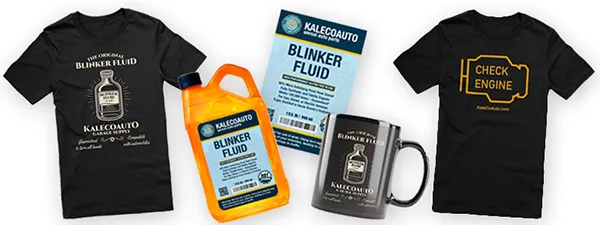
KaleCoAuto Merch
You made it this far. Treat yourself.
Related Items
Testimonials
KaleCoAuto Classic Version:
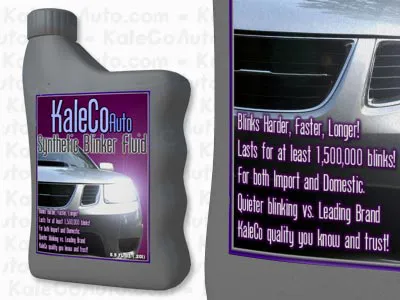
Classic Blinker Fluid
Are you blinkers sluggish? Do they make an annoying ticking noise? Do they not flash fast enough? Here’s your solution. Little do people know, factory quality blinker fluid should be changed every 150,000 blinks. Our blinker fluid lasts ten times that. KaleCoAuto high quality synthetic blinker fluid meets the highest DOT standards while not being in the least bit DOT legal! KaleCoAuto blinker fluid provides you with thousands of hours of reliable blinking without the wear and tear on the flash-synchro’s that the other blinker fluids cause. KaleCoAuto blinker fluid will not lose its viscosity even in the most extreme situations. Why buy that old dino-blinker fluid, when you can get our unique patented synthetic formula? Satisfaction guaranteed!! For use in any car.